
delim @@
| 5i'
TERMINAL EQUIPMENT FOR USE IN THE TELETEX SERVICE
(Geneva, 1980; amended at Malaga-Torremolinos, 1984
and Melbourne, 1988)
1.1 This Recommendation defines the requirements for terminal equipment used in the international Teletex service
1.2 The rules to be followed in the Teletex service are defined in Recommendation F.200.
1.3 The character repertoire and the coded character sets for the Teletex service are defined in Recommendation T.61.
|
1.4 All Teletex terminals have to communicate with unique procedures that are described as follows: a) the interface to the transport network is defined in this Recommendation, see § 6; b) the transport end-to-end control procedure is defined in Recommendation T.70; c) the Teletex control procedures are defined in Recommendation T.62. 1.5 Requirements for terminals providing mixed-mode capability are specified in Recommendation T.72. |
2.1 With the aid of a Teletex terminal it is possible to produce character-coded texts and to transmit their true contents and form to a receiving terminal.
2.2 A Teletex terminal , operating in the local mode, can also be used like a typewriter to prepare ordinary office documents. By means of the Teletex communication facilities, the text thus prepared can be transmitted to other Teletex terminals or received from them.
2.3 In this Recommendation text refers to character-coded text only.
2.4 Terminals can have various degrees of complexity. Within this Recommendation the emphasis is on requirements for correct interworking of different terminals.
2.5 Details are given on dimensions and positioning of text. Various dimensions refer to the presentation of text on paper. In this respect, paper formats of both 210 × 297 mm (ISO A4) and 216 × 280 mm are taken into account. Other paper sizes are included as options.
Fascicle VII.3 -- Rec. T.60 1
2.6 Terminals fulfilling the requirements denoted as basic requirements can participate in the Teletex service on a defined level of compatibility
3.1 Basic characteristics
3.1.1 The Teletex terminal allows text to be communicated from any subscriber to any other subscriber.
3.1.2 All terminals participating in the international Teletex service have to be compatible with one another at the basic level defined in this Recommendation. Additional optional functions may be invoked.
3.1.3 In order to support a high grade of service, a user data rate of 2.4 kbit/s on the subscriber line is recommended wherever possible. Detailed arrangements on a national level are left to the Administrations concerned, as it is recognized that national implementation of the Teletex service on various types of network may involve national operation at different data throughput rates.
2 Fascicle VII.3 -- Rec. T.60
3.1.4 When operated in the local mode, e.g. when the Teletex terminal is used in the same way as an office typewriter, the operation in the local mode should not be interrupted by incoming traffic. However, under receive store full conditions, the production of a permanent copy of the incoming messages must have priority over the local mode. In this context, a permanent copy is understood to be, e.g., paper, tape, magnetic media, etc., except volatile memory devices (such as semi-conductor memory without battery back-up).
A compulsory printout due to full memory (interruption of the local mode of operation) is not required.
3.1.5 In the sending mode, the Teletex terminal must be capable of sending a selection of characters that belong to the basic repertoire of graphic characters.
3.1.6 In the receiving mode, the Teletex terminal must be capable of receiving into store all characters from the basic repertoire of graphic characters.
3.1.7 The presentation device of the terminal must have the ability to represent as legibly as possible all graphic characters of the basic international Teletex character repertoire. Unambiguous presentation of the basic international Teletex character repertoire is a minimum requirement.
3.1.8 The terminal must have the ability to respond to the control functions of the basic international Teletex repertoire
3.1.9 The use of graphic character repertoires other than the Teletex basic repertoire of graphic characters is subject to ascertaining the mutual capability of the terminals and has to be initiated by the appropriate procedural steps.
3.1.10 The page is the basis for text formatting and text transmission.
3.1.11 The terminal must be able to handle paper formats in both the vertical and horizontal orientation (see § 4.2 below).
3.1.12 A printable area of the page is defined within which free positioning of the text is possible during local text preparation (see § 4.2 below).
3.1.13 After transmission, the content, layout and format of a Teletex message must be identical at the transmitting and the receiving terminals, when using the defined basic mode of Teletex operation.
3.1.14 The Teletex terminal must be provided with storage for transmitting and receiving functions. See § 5.2 for further details.
3.1.15 The Teletex terminal must provide means for fully automatic operation (see definitions in Recommendation F.200).
3.1.16 For the purpose of automatic operation, an internationally agreed unique terminal identification must be provided (see § 5.1 for further details).
3.1.17 The basic Teletex terminal should provide the capability of interworking with telex. Necessary constraints on the Teletex terminal are defined in § 8.
3.1.18 Teletex terminals shall incorporate all functions defined as basic for the Teletex service in § 3.2 below. In addition, optional functions can be incorporated. In this Recommendation, the optional functions are divided into CCITT-standardized options (§ 3.3) and nationally and/or privately specified options (§ 3.4).
3.1.19 This Recommendation does not specify requirements for receive-only terminals. However, it is not intended to exclude such terminals.
3.2 Basic functions
3.2.1 A terminal shall be capable of handling:
a) the end-to-end control procedures as defined in Recommendations T.62 and T.70;
Fascicle VII.3 -- Rec. T.60 3
|
b) c) d) e) f ) |
the appropriate network-dependent procedure, see § 6; the Teletex basic graphic character repertoire; the Teletex basic control function repertoire; text in the basic vertical and horizontal page formats; subscripts and superscripts. |
3.2.2 Basic text formatting functions for printers (or other presentation devices as applicable) are as follows:
a) vertical and horizontal page orientation;
b) printable area common to ISO A4 and 216 × 280 mm paper formats;
4 Fascicle VII.3 -- Rec. T.60
|
c) d) e) |
character spacing of 2.54 mm (10 characters per 25.4 mm); line feed parameter values of 0.5, 1, 1.5 and 2 spacings of 4.233 mm (six spacings of 4.233 mm equals free positioning of text within the printable area using the Teletex basic repertoire of graphic characters |
and control functions;
f ) partial line up and partial line down functions (for presenting superscript and subscript).
3.2.3 The following Teletex service requirements must be met:
|
a) b) c) d) Note |
terminal identification; storage for receiving and transmitting functions; provisions for a permanent copy (not necessarily on paper) of all text received; provisions for interworking with the telex service. -- The use of the terminal identification (transmission, reception) is a matter for the communication |
procedure (see Recommendation T.62).
3.3 CCITT-standardized optional functions
3.3.1 The possibility of using optional functions can be negotiated between terminals during a handshaking procedure in the end-to-end control procedure (see Recommendation T.62).
3.3.2 As the service develops, additions and changes to the CCITT-standardized optional functions listed below may be needed.
|
3.3.3 For the optional functions of the communication control procedures, see Recommendations T.62 and T.70. 3.3.4 Optional text formatting functions for printers (or other presentation devices as applicable) are to be found |
||
|
in: |
||
|
a) Annex B to this Recommendation; b) Annex E to Recommendation T.61. 3.3.5 Alternative character repertoires may be invoked by designation of CCITT-registered national and/or |
application-oriented character repertoires.
Note -- The definition and designation of CCITT-registered national and/or application-oriented character repertoires is a matter for study in the future.
3.3.6 For Teletex terminals supporting the mixed mode of operation (MM), additional terminal characteristics are specified in Recommendation T.561.
3.3.7 For Teletex terminals supporting the processable mode (PM.1), additional terminal characteristics are specified in Recommendation T.562.
3.4 Optional functions for national standardization or private use
3.4.1 The CCITT standardization includes the necessary rules and means for indication of or escape into functions specified nationally or for private use (see standardized options in Recommendation F.200).
Fascicle VII.3 -- Rec. T.60 5
|
3.5 |
Default conditions 3.5.1 In the absence of specific indication, the receiving terminal shall assume the following conditions: a) communication (as specified in Recommendation T.62): -- one way (calling terminal is transmitting text), -- normal document; b) character repertoire -- basic international Teletex character repertoire; c) text presentation: -- vertical basic page format, -- character spacing of 2.54 mm, -- line-feed spacing of 4.23 mm (single spacing), -- default rendition. |
|
|
6 |
Fascicle VII.3 -- Rec. T.60 |
4.1 Character repertoire
4.1.1 The terminal, participating in the international Teletex service, can exchange text with all other Teletex terminals. To enable this communication, the international Teletex basic graphic character and control function repertoires, as defined in Recommendation T.61, shall be used.
4.1.2 On an optional basis a terminal can use other national and/or application-oriented character repertoires registered by CCITT. The rules for the code extension technique are described in Recommendation T.61.
4.2 Paper sizes and printable areas
4.2.1 If the Teletex terminal is capable of printing text on paper, it has to act like a normal office typewriter. Therefore the following applies.
4.2.2 There are countries that use ISO A4 paper size (210 × 297 mm) or North-American paper size (216 × 280 mm) of which the common area is 210 × 280 mm.
4.2.3 Printable areas are defined for both the vertical and horizontal orientation of the paper, and are expressed by the number of line positions and character positions shown in Table 1/T.60.
4.2.4 The printable areas include an allowance for printing with an offset of 2.12 mm above the first base line and 2.12 mm below the last base line for superscripts and subscripts respectively.
4.2.5 For the definitions of the printable areas in Table 1/T.60 certain assumptions about technical and operational problems have been taken. Further details about these assumptions are given in Annex A.
H.T. [T1.60]
TABLE 1/T.60
Basic printable areas and basic page formats
|
center box; cw(54p) sw(54p) , c | c. Paper orientation Vertical Horizontal _ cw(60p) | cw(60p) | cw(54p) | cw(54p) . { Maximum number of lines per page | ua) } { Line spacing (mm) 4.23 6.35 8.47 } X = 110 HLS 55 37 28 X = 76 HLS 38 25 19 _ cw(60p) | cw(60p) | cw(54p) | cw(54p) . |
|
{ Maximum number of characters per line | ub) } Character spacing (mm) 2.54 { Character spacing (mm) 77 (5 + 72) } Character spacing (mm) 105 (5 + 100) a) The maximum number of lines per page is calculated according to the formula given. |
|
|
b) |
|
|
The maximum number of characters per line are given in the form C |
|
| D + E ), where C | s the total number of characters per line defined for the printable area, D | the number of characters to the left side of the home position as defined for the page format and E | the number of characters to the right side including the home position character. The home position is defined in Figure B-1/T.60. Table 1/T.60 [T1.60], p. Fascicle VII.3 -- Rec. T.60 7 |
4.2.6 It is not the intention of this Recommendation to define precisely the location and the size of the printable areas on paper sheets. However, the design of printing equipment shall always provide for the maximum number of lines and the maximum number of characters per line as shown in Table 1/T.60.
|
Note -- The optional use of preprinted forms needs further study 4.2.7 Optional printable areas are found in Annex B. |
||
|
4.3 |
Page format 4.3.1 The size of the communicated text area, vertically or horizontally oriented, is one line spacing (4.23 mm) less than the defined |
maximum printable area, to allow for presentation of the call identification line
4.3.2 The call identification line, if presented, will appear preferably at the superscripted level of the first printable line or the subscripted level of the last printable line, to ensure that it cannot partially overlap superscript text in the first communicable text line , or subscript text in the last communicable text line
Note -- Some existing equipment may be unable to comply with the requirement. If overlapped printing occurs on such terminals, it will be the recipient's responsibility to obtain clarification of text from the sender.
4.3.3 For each text area a home position is defined. See Recommendations T.61 and F.200.
Note -- The home positions for different character spacings are shown in Figure B-1/T.60.
5.1 Terminal identification
5.1.1 Each Teletex terminal shall be equipped with a unique terminal identifier stored in the terminal.
5.1.2 The terminal identifier consists of 24 characters (octets) to which it shall be possible to assign any permissible bit combination of the primary set of Recommendation T.61.
The content and restrictions of the terminal identifier are defined in Recommendation F.200.
5.1.3 The content of the terminal identifier must be protected against loss or modification due to technical faults or non-authorized intervention.
5.1.4 The Teletex communication procedures include the exchange of the terminal identifiers prior to sending any document. The sender should use the receivers identifier to check the correct establishment of the call. If an automatic check is performed, this is preferably done on the mnemonic part of the terminal identifier, i.e. the part following the equals sign (=), see Recommendation F.200.
|
5.2 |
Storage 5.2.1 The terminals have to be equipped with a memory for reception, transmission and undisturbed local operation. 5.2.2 The storage ability of a terminal to receive incoming traffic may be established by control procedures prior to message transmission. 5.2.3 If the transmission has to be terminated as a result of insufficient storage at the receiving end, indication of this condition will be given |
to both the transmitting and receiving parties.
5.2.4 The storage capacity shall be sufficient to meet the quality of service criteria laid down in Recommendation F.200.
5.2.5 Terminal design and/or operating procedures shall be such as to minimize the possibility of loss of messages due to power failure or memory failure (for example by the use of nonvolatile memory or by forced print-out as appropriate).
8 Fascicle VII.3 -- Rec. T.60
5.3 Call identification
5.3.1 The Teletex procedures include the exchange of reference information prior to sending any document. Details of the call identification line are covered in Recommendation F.200.
6.1 Teletex transport can be provided by a circuit-switched data network (CSDN), a packet-switched data network (PSDN) or a public switched telephone network (PSTN). In all three types of network the Teletex terminal will provide automatic answering, transmission, reception and clearing.
|
6.2 |
Circuit-switched data network |
|||
|
a) b) c) |
functional and procedural rules for the call control phase: Recommendation X.21; bit rate: 2400 bit/s; link and network layer procedures during the data transfer phase: duplex as defined in Recommendation T.70. |
|||
|
6.3 |
Packet-switched data network |
|||
|
a) b) |
functional and procedural rules for the call control phase: Recommendation X.25; bit rates: 2400, 4800, 9600 and 48 | 00 bit/s. |
|||
|
6.4 |
Public switched telephone network |
|||
|
a) |
functional and procedural rules for the call control phase in the case of automatic calling and answering: Recommendation V.25 line |
requirements for automatic calling and answering;
b) bit rates: half-duplex 2400 bit/s; duplex 1200 or 2400 bit/s; Recommendation V.22, V.22 | fIbis or V.26 | fIter modem line requirements;
Note -- V.22 | fIbis line requirements are preferable to V.22.
c) link and network layer procedures during data transfer phase : Recommendation T.70 and in the case of half-duplex operation also Recommendation T.71.
7.1 Indicators should inform about situations in which operator attention is required in order to maintain the grade of service.
7.2 An indication of the following situations shall be provided:
a) message received in store;
b) terminal unable or soon unable to receive, e.g. when receiving memory is nearly full;
c) operator assistance required, e.g. when printing element or paper orientation requires changing.
The terminal operator's attention shall be drawn to the above situations immediately regardless of the actual condition of the terminal, e.g. when terminal is in stand-by mode.
Fascicle VII.3 -- Rec. T.60 9
8.1 In text which is to be sent to a telex terminal , the graphic character set should be restricted to that of International Telegraph Alphabet No. 2 (ITA2). This restriction only applies to that part of the text which is for onward transmission to telex. This restriction should be performed in the Teletex terminal.
10 Fascicle VII.3 -- Rec. T.60
8.2 The text for onward transmission to telex shall only contain those characters of ITA2 that form a subset of the basic Teletex character repertoire, as specified in Table C-1/T.60. Coding of these characters shall be in accordance with Recommendation T.61.
8.3 For the new line function , it is strongly recommended to use CR and LF in the order CR followed by LF. The order LF followed by CR is deprecated because this may cause improper printing in certain telex terminals.
8.4 The line length is restricted to 69 characters.
8.5 The Teletex terminal, when interworking with telex, operates at the Teletex terminal's normal data signalling rate.
8.6 The control procedures to be used between a Teletex terminal and a conversion facility (see Recommendation F.200) are defined in Recommendation T.90.
Note -- A conversion facility provides for necessary conversion between Teletex and telex of communication procedures, signalling rates, character coding, etc.
9.1 General
Basic Teletex documents are to be interchanged according to the rules defined in Recommendation T.62 | fIbis .
PM.1 and MM Teletex documents are to be interchanged according to the application context defined in Recommendations T.561 and T.562.
Figure 1/T.60 below illustrates the two different sets of rules to be used by Teletex equipments depending on the interchanged document format.
Figure 1/T.60, p. 9.2 Interworking rules
9.2.1 The basic Teletex equipment is the sender.
Fascicle VII.3 -- Rec. T.60 11
The only type of document that can be sent by the basic Teletex equipment is the basic Teletex document. The sender should therefore try to send this type of document by using the appropriate rules, i.e. T.62 | fIbis rules.
12 Fascicle VII.3 -- Rec. T.60
In order to accept the reception of the basic Teletex document, the receiver has to recognize the ``nature'' of the originator and to select the adequate rules. For this purpose, when receiving the CONNECT SPDU (which corresponds to the CSS command of Recommendation T.62), the recipient must detect the absence of Session User Data (SUD) and select the T.62 | fIbis module to accept the interchanged document [case a)].
9.2.2 The PM.1/MM Teletex equipment is the sender.
9.2.2.1 The recipient is a basic Teletex equipment.
If the document type to be transmitted is a basic Teletex document, the sender will initiate the communication by selecting the T.62 | fIbis module [case a)] and the basic Teletex equipment can accept the document.
If the document type to be transmitted is a PM.1/MM document, the sender will initiate the communication by selecting the T.522 module [case b)].
The receiver will then send an ACCEPT SPDU without Session User Data. This allows the sender to recognize that the receiver is a basic Teletext equipment and therefore that the documents are to be interchanged in a basic Teletex format by using T.62 | fIbis communication rules [case a)], the sender could then inform the user that the interchange of the PM.1/MM document is not possible as the addressee is a basic Teletex equipment.
9.2.2.2 The recipient is a PM.1 and/or MM Teletex equipment.
If the document type to be transmitted is a basic Teletex document, the sender will initiate the communication by selecting the T.62 | fIbis module [case a)] and the rules specified in § 2.1 apply.
If the document type to be transmitted is a PM.1 or MM.1 Teletex document the sender will initiate the communication by selecting the T.522 module [case b)].
The recipient will detect the presence of Session User Data and therefore will select the T.522 module to give an adequate response to the sender.
ANNEX A
(to Recommendation T.60)
Explanations of the printable areas
A.1 The content of this annex does not form part of the requirements laid down by this Recommendation; instead it gives explanations of how the printable areas in Table 1/T.60 were defined.
A.2 The maximum printable area is defined to be the paper area available to the printing mechanism onto which graphic information can be technically impressed.
A.3 The following parameters were considered:
|
a) b) c) d) |
the use of a common paper area of 210 × 280 mm; the worst case conditions for tolerances of paper size and of paper insertion as in Figure A-1/T.60; the need to have the paper sheet held secure in the paper feed mechanism during the whole printout; the use of line spacings of 4.23, 6.35 and 8.47 mm and a character spacing of 2.54 mm. The values for line spacings are rounded off |
to two decimal places (six spacings of 4.23 mm equal 25.4 mm);
e) the location of characters and base lines on a paper sheet as shown in Figure A-2/T.60;
f ) the allowance to print exponents and indices with an offset of not more than 2.12 mm above and below the first and last base lines respectively.
A.4 The parameters in § A.3 lead to the values for the position of the first and last printable characters as in Table A-1/T.60 and Figure A-2/T.60, and are given as examples only.
Fascicle VII.3 -- Rec. T.60 13
|
H.T. [T2.60] TABLE A-1/T.60 |
FIGURE A-1/T.60, p. |
|||
|
center box; lw(60p) | cw(60p) | cw(60p) . |
Best line position Character position _ Unable to convert table |
|||
|
Table A-1/T.60 [T1.60], p. |
||||
|
14 Fascicle VII.3 -- Rec. T.60 |
FIGURE A-2/T.60, p. Fascicle VII.3 -- Rec. T.60 15
ANNEX B
(to Recommendation T.60)
Standardized
options for printable areas
|
This annex contains standardized optional values for different sizes of maximum printable areas. |
||
|
B.1 |
Options for presentation within the basic maximum printable areas B.1.1 Table B-1/T.60 contains the values for the usage of different optional character and line spacings. B.1.2 In Figure B-1/T.60, the location of the home position for different character spacings is defined. |
|
|
B.2 |
Options for presentation within ISO A4 paper size B.2.1 With the same assumptions as used for the basic printable areas and described in this Recommendation (§ 4 and Annex A), the |
appropriate maximum printable areas for the ISO A4 paper sheet (210 × 297 mm) and the values for different optional presentation attributes are found in Table B-2/T.60.
B.2.2 The optional printable areas for ISO A4 paper sheets defined by the ISO International Standard 3535 and the United Nations layout key -- and the associated page formats -- are those shown in Table B-3/T.60.
The part of the printable area intended for presentation of the communicated text are assumed to be located on the ISO A4 paper sheet as follows (compare Figure A-2/T.60):
|
-- For vertical paper orientation: First line of communicated text: 3rd base line Last possible line for communicated text: 68th base line. -- For horizontal paper orientation: First line of communicated text: 5th base line Last possible line for communicated text: 48th base line. The 2nd (resp. 4th) base line is assumed for the locally defined presentation of the call identification line. Presentation of superscript and subscript on the first and last base line respectively is not assumed for these printable areas. |
|||
|
B.3 |
Options for presentation within ISO paper sizes used with Japanese Kanji terminals B.3.1 Optional printable areas for ISO A4 paper size for use with Japanese Kanji terminals are shown in Table B-4/T.60. B.3.2 Optional printable areas for ISO B5 paper size for use with Japanese Kanji terminals are shown in Table B-5/T.60. B.3.3 Optional printable areas for ISO B4 paper size for use with Japanese Kanji terminals are shown in Table B-6/T.60. |
||
|
16 |
Fascicle VII.3 -- Rec. T.60 |
B.4 Options for presentation with North American legal paper size
B.4.1 The optional printable areas for North American legal paper size (216 × 356 mm) are shown in Table B-7/T.60.
Fascicle VII.3 -- Rec. T.60 17
B.5 Calculation of the maximum number of lines per page
In calculating the maximum number of lines per page one must be aware of the following calculation problem:
-- when using a line spacing of 1 1/2 there is always the combination of 2 half-line spacing text (the text-line itself) plus 1 half-line spacing of free space;
-- when using a line spacing of 2 there is always the combination of 2 half-line spacing text (the text-line itself) plus 2 half-line spacings of free space.
There is always one ``free space line'' less than text lines.
Example (using line spacing 2 [SVS(2)])
spacingsxxxx1.lignexxxxxxfor ``free-space''2 half-linexxxx3.lignexxxxxxspacing for text2 2half-linehalf-linespacingsspacingsforfortext``free space'' xxxx2.lignexxxxxx 2 half-line spacings for text 2 half-line
Although at the first sight when using double-line spacing [SVS(2)] 3 lines need 3 times 4 half-line spacings (equal to 12 half-line spacings), the example shows that 2 half-line spacings less (namely 10 half-line spacings) are sufficient. The reason is simple, as mentioned above, that one always need one ``free-space'' less than real text lines.
Taking this into account a calculation is only correct, when one of the text lines is taken out at the beginning of the calculation and added at the end, thus allowing the devision by ``complete lines'' (text-line plus ``space-line'').
|
Based on these principles, the calculations are made using the formula n = @ { fIX~--~d } over { fIs } @ + 1 |
|
|
wherein |
|
n X d s |
maximum number of lines per page, measured in [lines], size of available area, excluding CIL and offsets, measured in [HLS], size of one text-line, which value is exactly 2 HLS, value of line-spacing, measured in [HLS/line]. |
Note -- In the following tables the term [HLS] stands for 1/12 of 25.4 mm.
When using a line spacing of 3.175, the term [HLS*] is used, being based on 1/16 of 25.4 mm.
When using a line spacing of 5 mm, the term [HLS**] is used, being based on 2.5 mm.
18 Fascicle VII.3 -- Rec. T.60
H.T. [T3.60]
TABLE B-1/T.60
Options for presentation within the basic maximum printable
areas
(see § 4)
|
center box; cw(54p) sw(54p) , c | c. Paper orientation Vertical Horizontal _ cw(60p) | cw(60p) | cw(54p) | cw(54p) . { Maximum number of lines per page } { Line spacing (mm) 3.175 5. } { X = 146 HLS | ua) } X = 101 HLS | ua) 73 46 |
|
|
{ Maximum number of50characters32 _ cw(60p)per line| cw(60p)| ub) | cw(54p) | cw(54p) . |
|
} } } } |
{ Character spacing (mm) 2.12 1.69 { Character spacing (mm) 92 (6 + 86) 115 (7 + 108) { Character spacing (mm) 125 (6 + 119) 156 (7 + 149) |
a) X is the total available size for text to be communicated, measured in half-line spacings, excluding the CIL and excluding the offset for sub- and superscripted presentations.
b) The maximum number of characters per line are given in the form C
|
| D + E ), where C | s the total number of characters per line defined for the printable area, D | he number of characters on the left side of the home position as defined for the page format (see Figure B-1/T.60) and E | he number of characters to the right side including the home position character. Tableau B-1/T.60 [T3.60], p.6 Figure B-1/T.60, p.7 Fascicle VII.3 -- Rec. T.60 19 |
H.T. [T4.60]
TABLE B-2/T.60
Optional printable areas/page formats and associated
values for ISO A4 paper size
|
center box; cw(54p) sw(54p) , c | c. Paper orientation Vertical { Maximum number of lines per page } { Line spacing (mm) 4.23 6.35 8.47 } { X = 118 HLS | ua) } { X = 76 HLS | ua) 59 39 30 |
Horizontal _ cw(60p) | cw(60p) | cw(54p) | cw(54p) . |
||
|
} _ cw(60p) | cw(60p) | 38cw(54p)25 19 | cw(54p) . |
|||
|
{ Maximum number of lines per page } { Line spacing (mm) 3.175 } X = 157 HLS* | ua) |
|
{ Maximum number of 78lines perXpage= 101 HLS* | ua) 50 _ cw(60p) | cw(60p) | cw(54p) | cw(54p) . |
|
|
} { Line spacing (mm) 5.175 } X = 99 HLS** | ua) { Maximum number of characters49 X =per64lineHLS**| ub)| ua) 32 _ cw(60p) | cw(60p) | cw(54p) | cw(54p) . |
|
|
} { Character spacing (mm) 2.54 2.12 1.69 } { Character spacing (mm) 77 (5 + 72) 92 (6 + 86) 115 (7 + 108) } { Character spacing (mm) 110 (5 + 105) 132 (6 + 126) 165 (7 + 158) } a) |
|
|
See footnote | ua) |
|
|
to Table B-1/T.60. b) |
|
|
See footnote | ub) |
|
|
to Table B-1/T.60. |
|
Tableau B-2/T.60 [T4.60], p.8 |
|||
|
H.T. [T5.60] TABLE B-3/T.60 Optional printable areas/page formats and associated values corresponding to ISO 3535/A4 |
|
center box; cw(54p) sw(54p) , c | c. Paper orientation Vertical { Maximum number of lines per page } { Line spacing (mm) 4.23 6.35 8.47 } { X = 132 HLS | ua) } { X = 88 HLS | ua) 66 44 33 |
Horizontal _ cw(60p) | cw(60p) | cw(54p) | cw(54p) . |
||
|
} _ cw(60p) | cw(60p) | 44cw(54p)29 22 | cw(54p) . |
|||
|
{ Maximum number of lines per page } { Line spacing (mm) 3.175 } X = 176 HLS* | ua) |
|
{ Maximum number of 88lines perXpage= 117 HLS* | ua) 58 _ cw(60p) | cw(60p) | cw(54p) | cw(54p) . |
|
|
} { Line spacing (mm) 5.175 } X = 111 HLS** | ua) { Maximum number of characters55 X =per74lineHLS**| ub)| ua) 37 _ cw(60p) | cw(60p) | cw(54p) | cw(54p) . |
|
|
} { Character spacing (mm) 2.54 2.12 1.69 } { Character spacing (mm) 77 (5 + 72) 92 (6 + 86) 115 (7 + 108) } { Character spacing (mm) 110 (5 + 105) 132 (6 + 126) 165 (7 + 158) } a) |
|
|
See footnote | ua) |
|
|
to Table B-1/T.60. b) |
|
|
See footnote | ub) |
|
|
to Table B-1/T.60. |
Tableau B-3/T.60 [T5.60], p.9 20 Fascicle VII.3 -- Rec. T.60
H.T. [T6.60]
TABLE B-4/T.60
Optional printable areas/page formats and associated
values for ISO A4 paper size
(Standardized option for Japanese Kanji terminals)
|
center box; cw(54p) sw(54p) , c | c. Paper orientation Vertical Horizontal _ cw(60p) | cw(60p) | cw(54p) | cw(54p) . { Maximum number of lines per page } { Line spacing (mm) 4.23 6.35 8.47 } { X = 118 HLS | ua) } { X = 76 HLS | ua) 59 39 30 |
|
|
} _ cw(60p) | cw(60p) | 38cw(54p)25 19 | cw(54p) . |
|
|
{ Maximum number of characters per line | ub) } Character spacing (mm) 4.23 { Character spacing (mm) 45 (4 + 41) |
} { Character spacing (mm) 66 (4 + 62)
|
} a) |
|
|
See footnote | ua) |
|
|
to Table B-1/T.60. b) |
|
|
See footnote | ub) |
|
|
to Table B-1/T.60. |
Tableau B-4/T.60 [T6.60], p.10 |
H.T. [T7.60]
TABLE B-5/T.60
Optional printable areas/page formats and associated
values for ISO B5 paper size
(Standardized option for Japanese Kanji terminals)
|
center box; cw(54p) sw(54p) , c | c. Paper orientation Vertical Horizontal _ cw(60p) | cw(60p) | cw(54p) | cw(54p) . { Maximum number of lines per page } { Line spacing (mm) 4.23 6.35 8.47 } { X = 98 HLS | ua) } { X = 64 HLS | ua) 49 33 24 |
|
|
} _ cw(60p) | cw(60p) | 32cw(54p)21 16 | cw(54p) . |
|
|
{ Maximum number of characters per line | ub) } Character spacing (mm) 4.23 { Character spacing (mm) 38 (4 + 34) |
} { Character spacing (mm) 56 (4 + 52)
|
} a) |
|
|
See footnote | ua) |
|
|
to Table B-1/T.60. b) |
|
|
See footnote | ub) |
|
|
to Table B-1/T.60. |
Tableau B-5/T.60 [T7.60], p.11 |
Fascicle VII.3 -- Rec. T.60 21
H.T. [T8.60]
TABLE B-6/T.60
Optional printable areas/page formats and associated
values for ISO B4 paper size
(Standardized option for Japanese Kanji terminals)
|
center box; cw(54p) sw(54p) , c | c. Paper orientation Vertical Horizontal _ cw(60p) | cw(60p) | cw(54p) | cw(54p) . { Maximum number of lines per page } { Line spacing (mm) 4.23 6.35 8.47 } { X = 150 HLS | ua) } { X = 98 HLS | ua) 75 50 38 |
|
|
} _ cw(60p) | cw(60p) | 49cw(54p)33 25 | cw(54p) . |
|
|
{ Maximum number of characters per line | ub) } Character spacing (mm) 4.23 { Character spacing (mm) 56 (4 + 52) |
} { Character spacing (mm) 79 (4 + 75)
|
} a) |
|
|
See footnote | ua) |
|
|
to Table B-1/T.60. b) |
|
|
See footnote | ub) |
|
|
to Table B-1/T.60. |
Tableau B-6/T.60 [T8.60], p.12 |
H.T. [T9.60]
TABLE B-7/T.60
Optional printable areas/page formats and associated
values for North American Legal paper size (216 mm × 356 mm)
|
center box; cw(54p) sw(54p) , c | c. Paper orientation Vertical Horizontal _ cw(60p) | cw(60p) | cw(54p) | cw(54p) . { Maximum number of lines per page } { Line spacing (mm) 4.23 6.35 8.47 } { X = 146 HLS | ua) } { X = 78 HLS | ua) 73 49 37 |
|
|
} _ cw(60p) | cw(60p) | cw(54p)39 26 20 | cw(54p) . |
|
|
{ Maximum number of lines per page } { Line spacing (mm) 3.175 } X = 194 HLS* | ua) { Maximum number of characters97 X =per104lineHLS*| ub)| ua) 52 _ cw(60p) | cw(60p) | cw(54p) | cw(54p) . |
|
} } } } |
{ Character spacing (mm) 2.54 2.12 1.69 { Character spacing (mm) 80 (5 + 75) 96 (6 + 90) 120 (7 + 113) { Character spacing (mm) 135 (5 + 130) 161 (6 + 155) 201 (7 + 194) |
a) See footnote | ua) to Table B-1/T.60.
|
b) |
||
|
See footnote | ub) |
||
|
to Table B-1/T.60. |
Tableau B-7/T.60 [T9.60], p.13 |
|
|
22 Fascicle VII.3 -- Rec. T.60 |
|
B.6 |
Options for presentation within ISO paper sizes used with Chinese ideogram terminal B.6.1 Optional printable areas for ISO A4 paper size used with Chinese ideogram terminal are shown in Table B-8/T.60. B.6.2 Optional printable areas for ISO B5 paper size used with Chinese ideogram terminal are shown in Table B-9/T.60. B.6.3 Optional printable areas for ISO B4 paper size used with Chinese ideogram terminal are shown in Table B-10/T.60. H.T. [T10.60] TABLE B-8/T.60 Optional printable areas/page formats and associated values for ISO A4 paper size (Standardized options for Chinese ideogram terminal) |
|
center box; cw(54p) sw(54p) , c | c. Paper orientation Vertical Horizontal _ cw(60p) | cw(60p) | cw(54p) | cw(54p) . { Maximum number of lines per page } { Line spacing (mm) 4.23 | uc) } { X = 118 HLS | ua) 6.35 | fRc) 8.47 | fRc) |
|
|
} { X = 76 HLS | ua) 59 39 30 |
|
|
} _ cw(60p) | cw(60p) | 38cw(54p)25 19 | cw(54p) . |
|
|
{ Maximum number of characters per line | ub) } { Character spacing (mm) 4.23 | fRc) 5.64 | fRc) 6.35 | fRc) |
} { Character spacing (mm) 45 (4 + 41) 33 (3 + 30) 30 (3 + 27)
} { Character spacing (mm) 66 (4 + 62) 49 (3 + 46) 44 (3 + 41)
|
} a) |
|
|
See footnote | ua) |
|
|
to Table B-1/T.60. b) |
|
|
See footnote | ub) |
|
|
to Table B-1/T.60. c) |
|
|
Line spacing of 4.23 mm will not be used when character spacing is 5.64 or 6.35 mm. |
Tableau B-8/T.60 [T10.60], p.14 |
Fascicle VII.3 -- Rec. T.60 23
H.T. [T11.60]
TABLE B-9/T.60
Optional printable areas/page formats and associated
values for ISO B5 paper size
(Standardized options for Chinese ideogram terminal)
|
center box; cw(54p) sw(54p) , c | c. Paper orientation Vertical Horizontal _ cw(60p) | cw(60p) | cw(54p) | cw(54p) . { Maximum number of lines per page } { Line spacing (mm) 4.23 | uc) } { X = 98 HLS | ua) 6.35 | fRc) 8.47 | fRc) |
|
|
} { X = 64 HLS | ua) 49 33 24 |
|
|
} _ cw(60p) | cw(60p) | 32cw(54p)21 16 | cw(54p) . |
|
|
{ Maximum number of characters per line | ub) } { Character spacing (mm) 4.23 | fRc) 5.64 | fRc) 6.35 | fRc) } { Chaaracter spacing (mm) 38 (4 + 34) 28 (3 + 25) 25 (3 + 22) |
} { Character spacing (mm) 56 (4 + 52) 42 (3 + 39) 37 (3 + 34)
|
} a) |
|
|
See footnote | ua) |
|
|
to Table B-1/T.60. b) |
|
|
See footnote | ub) |
|
|
to Table B-1/T.60. c) |
|
|
See footnote | uc) |
|
|
to Table B-8/T.60. |
Tableau B-9/T.60 [T11.60], p.15 |
H.T. [T12.60]
TABLE B-10/T.60
Optional printable areas/page formats and associated
values for ISO B4 paper size
(Standardized options for Chinese ideogram terminal)
|
center box; cw(54p) sw(54p) , c | c. Paper orientation Vertical Horizontal _ cw(60p) | cw(60p) | cw(54p) | cw(54p) . { Maximum number of lines per page } { Line spacing (mm) 4.23 | uc) } { X = 150 HLS | ua) 6.35 | fRc) 8.47 | fRc) |
|
|
} { X = 98 HLS | ua) 75 50 38 |
|
|
} _ cw(60p) | cw(60p) | 49cw(54p)33 25 | cw(54p) . |
|
|
{ Maximum number of characters per line | ub) } { Character spacing (mm) 4.23 | fRc) 5.64 | fRc) 6.35 | fRc) |
} { Character spacing (mm) 56 (4 + 52) 42 (3 + 39) 37 (3 + 34)
} { Character spacing (mm) 79 (4 + 75) 59 (3 + 56) 53 (3 + 50)
|
} a) |
|
|
See footnote | ua) |
|
|
to Table B-1/T.60. b) |
|
|
See footnote | ub) |
|
|
to Table B-1/T.60. c) |
|
|
See footnote | uc) |
|
|
to Table B-8/T.60. |
Tableau B-10/T.60 [T12.60], p.16 |
|
24 Fascicle VII.3 -- Rec. T.60 |
ANNEX C
(to Recommendation T.60)
Conversion table between the Teletex repertoire and
the telex repertoire for Teletex/telex interworking
H.T. [T13.60]
TABLE C-1/T.60
|
center box; cw(60p) | cw(54p) | cw(60p) | cw(54p) . ITA No. 2 Combination No. Telex repertoire Teletex T.61) _ cw(60p) | cw(54p) | cw(60p) | cw(54p) . { Letter case 1 2 3 . . . 24 25 26 } cw(60p) | cw(54p) | cw(60p) | cw(54p) . { A B C X Y Z } { a or A b or B c or C x or X y or Y z or Z } { LA01 or LA02 LB01 or LB02 LC01 or LC02 LX01 or LX02 LY01 or LY02 LZ01 or LZ02 } _ cw(60p) | cw(54p) | cw(60p) | cw(54p) . Figure case cw(60p) | cw(54p) | cw(60p) | cw(54p) . { 1 2 3 4 5 6 7 8 9 10 11 12 13 14 15 16 17 18 19 20 21 22 23 24 25 26 } { -- ? : WRU 3 Nat. use Nat. use Nat. use 8 BELL ( ) , 9 0 1 4 5 7 = 2 / 6 + } { -- ? : Note 1 3 Note 2 Note 2 Note 2 8 Note 1 ( ) , 9 0 1 4 5 7 = 2 / 6 + |
repertoire |
Identifier (Rec. |
} { SP10 SP15 SP13 ND03 ND08 SP06 SP07 SP11 SP08 ND09 ND10 ND01 ND04 SP05 ND05 ND07 SA04 ND02 SP12 ND06 SA01
|
} _ cw(60p) | cw(54p) | cw(60p) | cw(54p) . Either case letter-shift figure-shift SP NU } CR LF Note 3 Note 3 SP Note 1 { CF15 CF12 SP01 } |
cw(60p) | cw(54p) | cw(60p) | cw(54p) . 27 28 29 30 31 32 |
{ CR LF |
Note 1 -- Not defined in the teletex repertoire. It will not be transmitted from the conversion facility to the teletex terminal.
Note 2 -- The use of these characters is not defined in international teletex/telex interworking.
Note 3 -- This character is only used for communication between conversion and telex terminal and is not transmitted to the teletex terminal.
Table C-1/T.60 [T13.60] p.
Fascicle VII.3 -- Rec. T.60 25
ANNEX D
(to Recommendation T.60)
Definitions
D.1 printable area
A printable area is defined to be the paper area available to the printing mechanism onto which graphic information can be technically impressed.
D.2 page
A page is the basic element of office correspondence in the Teletex service. This term defines the information that can be presented on one sheet of paper. This information may be stored, displayed or printed.
Note -- Relevant paper sizes are indicated in this Recommendation.
D.3 text
Text is information for human comprehension that is intended for presentation in a two-dimensional form, e.g. printed on paper or displayed on a screen. Text consists of symbols, phrases or sentences in natural or artificial languages, pictures, diagrams and tables.
D.4 communicated text area
Area with a size of one line spacing (4.23 mm) less than the defined maximum printable area.
CHARACTER REPERTOIRE AND CODED CHARACTER SETS
FOR THE INTERNATIONAL TELETEX SERVICE
(Geneva, 1980; amended at Malaga-Torremolinos, 1984
and Melbourne, 1988)
CONTENTS
|
1 2 3 4 26 |
Introduction Definitions Teletex Coded Fascicle |
Introduction Definitions Teletex character repertoire Coded representations VII.3 -- Rec. T.61 |
|
Annex A Annex B Annex C Annex D Annex E Annex F |
-- -- -- -- -- -- |
Code extension procedures Use of diacritical marks Identification system Format of control sequences Standardized options Example of underlining |
Fascicle VII.3 -- Rec. T.61 27 |
Note -- Octets notation in Recommendation T.61.
Notation for identifying octets coding has been changed, referring to new ISO practice, decided within ISO/IEC JTC 1/SC2.
According to the new notation, each number now must have two figures according to the following examples:
H.T. [T1.61]
|
center box; cw(48p) | cw(48p) | cw(48p) . 0/4 to become 00/04 cw(48p) | cw(48p) | cw(48p) . cw(48p) | cw(48p) . 10/12 to become 10/12 cw(48p) | cw(48p) | cw(48p) . (previous notation) |
4/12 to become 04/12 cw(48p) | (new notation) _ Table [T1.61], p. |
|
|
The amendments of T.61 may be done in conformity to this new notation. Occurence of this new notation is indicated by a ``*'' sign on the right of the page. The existing text still remains with the previous notations. |
1.1 This Recommendation contains detailed definitions of the repertoires of graphic characters and control functions to be used in the basic international Teletex service, and their coded representations for communication. Additionally, the means are described whereby supplementary character repertoires and their coded representations may optionally be used.
1.2 In the Teletex service, control functions may be communicated as coded characters within the text or by means of the control procedures. This Recommendation defines the repertoire and coding of the former category.
1.3 The character repertoires and coded character sets for Teletex are not intended to replace International Alphabet No. 5 (IA5) or International Telegraph Alphabet No. 2 (ITA2). This Recommendation, based on Recommendation T.50, provides an extended alphabet for use in the international text communication service, Teletex. Where graphic characters of IA5 are not required for Teletex, their code table positions have been left unused, thereby assuring compatibility with IA5. The resulting subset of IA5 has been extended by the definition of additional graphic character sets.
1.4 The development of the coded character set defined in this Recommendation is based on the use of an 8-bit structure for the basic Teletex service.
1.5 This Recommendation should be read in conjunction with the following Recommendations:
|
T.60 T.62 F.200 1.6 The |
-- Terminal equipment for use in the Teletex service; -- Control procedures for Teletex and Groupe 4 Facsimile services; -- Teletex service. following Recommendations and ISO standards are related to this Recommendation, however, for the Teletex service this |
Recommendation only is relevant:
T.50 International Alphabet No. 5;
T.51 Coded character sets for the telematic services.
ISO 646 Information processing -- ISO 7-bit coded character set for information interchange;
28 Fascicle VII.3 -- Rec. T.61
|
ISO 2022 ISO 6429 devices; ISO 6937 |
Information processing -- ISO 7-bit and 8-bit coded character sets -- Code extension techniques; Information processing -- ISO 7-bit and 8-bit coded character sets -- Additional control functions for character imaging Information processing -- Coded character sets for text communication. |
1.7 This Recommendation contains ordered lists of graphic characters and control functions forming the Teletex basic repertoire, together with the coded character sets necessary for their communication. For this purpose, the elements of the coded character sets are used either individually or in defined combinations.
1.8 The optional use of additional character repertoires is provided for, but the composition of such repertoires is not defined. Similarly, the code extension techniques for the representation of the additional repertoires are described in general, but no specific allocations of code tables are made.
2.1 format effectors
S: determinantes de formato
Control functions that influence the positioning of text, within the text area, on a presentation device. The following concepts are used in defining format effectors.
|
2.1.1 |
active position F: position active S: posicion´ activa The character position where the next character would appear if it were presented. |
|
|
2.1.2 |
text area F: zone de texte S: zona de texto The part of a printed page that is actually used for the presentation of text. The active position moves within the text area only. For Teletex, |
the text area is the maximum printable area (see Recommendation T.60).
|
2.1.3 |
home position F: position initiale S: posicion´ inicial The reference position on any line to which the active position moves after a terminal receives a Carriage return . The starting position for |
printing is then established from this reference position by the sending terminal, using Space or Backspace characters as required.
2.2 presentation control functions
Fascicle VII.3 -- Rec. T.61 29
F: fonctions de commande pour la presentation´
S: funciones de control de la presentacion´
Control functions that influence in a uniform way the presentation attributes of the text (e.g. line spacing or page format) on a presentation device.
30 Fascicle VII.3 -- Rec. T.61
|
2.3 |
graphic code extension F: extension de code graphique S: extension´ del codigo´ grafico´ The method of encoding graphic characters in excess of those that may be represented by the 8-bit code combinations of the basic code |
table. Alternative sets of 94 graphic characters may be designated by means of escape sequences and invoked by means of shift functions. Depending on the designating escape sequence, the alternative sets of characters are represented by bit combinations of the left-hand half (positions 2/1 to 7/14 inclusive) or the right-hand half (positions 10/1 to 15/14 inclusive) of the 8-bit code table.
In the basic Teletex service, escape sequences and shift functions are not used. The primary set of graphic characters defined in § 4.1.3.3 is implicitly designated and invoked into positions 2/1 to 7/14 of the 8-bit code table. The supplementary set of graphic characters defined in §
4.1.3.4
is implicitly designated and invoked into positions 10/1 to 15/14 of the 8-bit code table.
Note -- As an enhancement to the basic Teletex service, national or application-oriented sets of graphic characters may be designated by means of appropriate escape sequences, thereby overlaying the primary and supplementary sets. Return to the primary and supplementary sets is accomplished by similar escape sequences.
2.4 Teletex character repertoire

S: repertorio teletex de caracteres
The total range of graphic characters and control functions that may be communicated between Teletex terminals.
2.5 Teletex graphic character repertoire

S: repertorio teletex de caracteres graficos´
The total range of graphic characters that may be communicated between and presented by Teletex terminals.
2.6 Teletex basic graphic character repertoire

S: repertorio teletex basico´ de caracteres graficos´
A comprehensive list of graphic characters whose communication is guaranteed by the Teletex service, and which are capable of being presented on all Teletex terminals.
|
2.7 |
Teletex control function repertoire F: repertoire´ des fonctions de commande tel´ etex´ S: repertorio teletex de funciones de control The total range of control functions communicated between Teletex terminals to enable the action of the receiving terminal to be |
controlled.
2.8 Teletex basic control function repertoire
Fascicle VII.3 -- Rec. T.61 31
F: repertoire´ des fonctions de commande tel´ etex´ de base
S: repertorio teletex basico´ de funciones de control
A comprehensive list of control functions communicated between Teletex terminals whose effect on the receiving terminal is defined and guaranteed by the service.
32 Fascicle VII.3 -- Rec. T.61
2.9 other teletex character repertoires

S: otros repertorios teletex de caracteres
National or application-oriented lists of graphic characters and control functions, in addition to the Teletex basic repertoires of graphic characters and control functions, that may be communicated between Teletex terminals by mutual agreement.
Note -- Specific additional character repertoires may be the subject of CCITT Recommendations.
2.10 character

S: caracter´
A member of a set of elements that is used for the organization control or representation of data. A character repertoire contains two types of elements: graphic characters and control functions.
|
2.11 |
control function F: fonction de commande S: funcion´ de control An action that affects the recording, processing, transmission or interpretation of data. The coded representation of a control function |
consists of one or more bit combinations. A control function is not a graphic character, but may have a graphic representation in some circumstances (e.g. for record purposes). It must not, however, be transmitted with the specific intent of producing a graphic representation.
2.12 control character

S: caracter´ de control
A control function, the coded representation of which consists of a single bit combination.
2.13 graphic character

S: caracter´ grafico´
A character, other than a control function, that has a visual representation normally hand-written, printed or displayed. The term graphic character is used with a dual meaning:
a) Graphic characters that are elements of a set that can be designated. These are called elementary graphic characters in order to distinguish them from the composite graphic characters . Some of the elementary graphic characters are used in combinations to represent composite graphic characters.
|
b) Graphic characters that are members of a repertoire. Some of combinations of elementary graphic characters . 2.14 presentation F: presentation´ |
these |
are |
composite graphic |
graphic |
characters |
characters represented |
represented |
by |
||||||
|
Fascicle |
VII.3 -- |
Rec. |
T.61 33 |
S: presentacion´
|
The printing or display of a stored character or characters to allow for human comprehension of the stored information. |
||
|
2.15 |
bit combination F: combinaison binaire S: combinacion´ de bits An ordered set of bits that represents a character. |
|
|
34 |
Fascicle VII.3 -- Rec. T.61 |
2.16 code, coded character set

S: codigo,´ juego de caracteres codificados
A set of unambiguous rules that establish a character set and the one-to-one relationship between the characters of the set and their bit combinations.
|
2.17 |
code table F: tableau de code S: tabla de codigo´ A table showing the character corresponding to each bit combination in a code. A code table is normally represented as a rectangular |
matrix of columns and rows.
|
2.18 |
position F: position S: posicion´ An item in a code table identified by its column and row coordinates. |
|
|
2.19 |
code extension F: extension de code S: extension´ de codigo´ Techniques for encoding characters that are not included in the character set of a given code. |
|
|
2.20 |
escape sequence F: sequence´ d'echappement´ S: secuencia de escape A bit string that is used for control purposes in code extension procedures and that consists of two or more bit combinations. The first of |
these combinations corresponds to the character escape .
2.21 to designate
F: designer´
S: designar
To identify a set of characters that are to be represented, in some cases immediately and in others on the occurrence of a further control function, in a prescribed manner.
2.22 to invoke
F: appeler
Fascicle VII.3 -- Rec. T.61 35
S: invocar
To cause a designated set of characters to be represented by the prescribed bit combinations.
3.1 General
3.1.1 The Teletex character repertoire is composed as defined below and as illustrated in Figure 1/T.61. 36 Fascicle VII.3 -- Rec. T.61
Figure 1/T.61 p.
3.1.2 The Teletex character repertoire consists of the Teletex repertoire of graphic characters and the Teletex repertoire of control functions .
3.1.3 The Teletex repertoire of graphic characters consists of the Teletex basic repertoire of graphic characters and the Teletex national and application-oriented repertoires of graphic characters . The basic repertoire of graphic characters is defined in § 3.2.
3.1.4 The Teletex repertoire of control functions consists of the Teletex basic repertoire of control functions and the Teletex national and application-oriented repertoires of control functions . The basic repertoire of control functions is defined in § 3.3.
3.1.5 The Teletex basic repertoire of graphic characters, together with the Teletex basic repertoire of control functions, constitute the Teletex basic character repertoire.
3.1.6 Bit combinations or sequences of bit combinations that do not represent graphic characters or control functions of the Teletex basic character repertoire, are not defined in this Recommendation.
Note -- With the Teletex sets of coded graphic characters and control functions it is, in principle, possible to produce combinations of diacritical marks and graphic characters other than those defined in the Teletex basic graphic character repertoire. However, the presentation of such composite symbols at the receiving terminal cannot be predicted and is therefore not defined in this Recommendation.
3.1.7 Sequences of graphic characters and control functions that would result in the presentation of two or more graphic characters in a single character position are not defined in this Recommendation.
Note -- It is possible, in text preparation, to overlay graphic symbols by the use of the control functions BS, SP, CR and RLF. However, no character of the Teletex basic graphic character repertoire shall be transmitted over the communication medium by this means. As it is normal office practice to create graphic symbols by overlaying graphic characters, the user cannot be prevented from using the keyboard to image locally composite symbols and the Teletex service shall not exclude the possibility of the transmission of these overlaid graphic symbols. The presentation of such overlaid graphic symbols at the receiving terminal cannot be predicted and is, therefore, not defined in this Recommendation. To prevent problems coming from overlaid characters, it is recommended not to transmit Backspace regardless of operator keying sequences, except in the left margin. However, because overlaid characters may be received from certain terminals, it is recommended that the terminal can represent the overlay. Similarly, an underline implemented by SGR or by Non spacing underline and followed by PLD may be a cause of overlap of graphic symbols. Although the definition of PLD in § 3.3.2 states that it is the sender's responsibility to avoid overlap, it may be difficult to prevent an accidental occurrence. In such cases the receiver may suppress printing of the underline to preserve legibility of the other graphic symbol.
Fascicle VII.3 -- Rec. T.61 37
3.1.8 The control functions of the Teletex basic repertoire enable a receiving terminal to produce a document that is identical in contents, layout and format, to that produced by the sending terminal.
3.1.9 The use of character repertoires other than the basic repertoire of graphic characters is subject to mutual agreement between terminals and shall be initiated by the appropriate procedural steps.
|
3.2 3.2.1 |
Teletex basic repertoire of graphic characters General 3.2.1.1 The repertoire of graphic characters defined in this Recommendation consists of: a) Latin alphabetic characters, listed in § 3.2.2, which comprise: i) the 52 small and capital letters of the basic Latin alphabet ; ii) accented letters and umlauts, the graphical representations of which consist of |
combinations of basic Latin letters and diacritical |
marks;
iii) alphabetic characters that are neither basic Latin letters nor combinations of basic Latin letters and diacritical marks;
b) non-alphabetic characters, listed in § 3.2.3, which comprise decimal digits, currency signs, punctuation marks (including Space ), diacritical marks , arithmetic signs, subscripts and superscripts, fractions, miscellaneous symbols that have individual special meanings and non-spacing characters.
3.2.1.2 The lists in §§ 3.2.2 and 3.2.3 are composed as described below:
|
a) Annex C; b) |
the first column contains the identifier of each character, assigned in accordance with the identification system explained in the second column presents the graphical representation of the character; |
|
|
c) |
the third column specifies the name or the description of the character. |
Note -- The repertoire of graphic characters defined in this Recommendation contains a limited set of accented letters and umlauts. This set is summarized in Annex B.
|
3.2.2 |
Latin alphabetic characters Identifier Graphic Name or description |
LA01 |
a |
small a |
|||||
|
LA02 A capital A LA11 a´ small a with acute accent LA12 A´ capital A with acute accent |


|
38 |
LA15 LA16 LA17 LA18 Fascicle |
| | a¨ A¨ VII.3 |
| | a¨ A¨ |
small capital small capital -- Rec. |
small a with circumflex accent capital A with circumflex accent small a with diaeresis or umlaut mark capital A with diaeresis or umlaut mark T.61 |


|
LG01 LG02 LG11 LG15 LG16 LG23 LG24 LG29 LG30 LG42 LH01 LH02 LH15 LH16 LH61 LH62 LI01 LI02 LI11 LI12 |
g G g´ ^g ^G g G g G G¸ h H ^h ^H h H i I i´ I´ |
small g G capital G small g with acute accent small g with circumflex accent capital G with circumflex accent small g with breve capital G with breve small g with dot capital G with dot capital G with cedilla small h capital H small h with circumflex accent capital H with circumflex accent small h with stroke capital H with stroke small i capital I small i with acute accent capital I with acute accent |


|
LI15 LI16 LI17 LI18 LI19 LI20 LI30 LI31 LI32 LI43 LI44 LI51 LI52 |
| | i¨ I¨ ~i ~I I i I i I ij IJ |
small i with circumflex accent capital I with circumflex accent small i with diaeresis or umlaut mark capital I with diaeresis or umlaut mark small i with tilde capital I with tilde capital I with dot small i with macron capital I with macron small i with ogonek capital I with ogonek small ij ligature capital IJ ligature |
Fascicle VII.3 -- Rec. T.61 41 |
|
LI61 LJ01 LJ02 LJ15 LJ16 LK01 LK02 LK41 LK42 LK61 LL01 LL02 LL11 LL12 LL21 |
i j J ^j ^J k K k¸ K¸ k l L l´ L´ l o l' |
small i without dot small j capital J small j with circumflex accent capital J with circumflex accent small k capital K small k with cedilla capital K with cedilla small k, Greenlandic small l capital L small l with acute accent capital L with acute accent small l with caron |
|
LL22 LL41 LL42 LL61 LL62 LL63 LL64 LM01 LM02 LN01 LN02 LN11 LN12 LN19 |
L o l¸ L¸ l L l L m M n N n´ N´ n~ |
L o L' l¸ small L¸ capital l small L capital l small L capital m small M capital n small N capital n´ small N´ capital n~ small |
capital L with caron small l with cedilla capital L with cedilla small l with stroke capital L with stroke small l with middle dot capital L with middle dot small m capital M small n capital N small n with acute accent capital N with acute accent small n with tilde |
|||
|
LN20 |
N~ |
N~ capital |
capital N with tilde |
|||
|
42 |
LN21 LN22 LN41 LN42 LN61 Fascicle |
n N n¸ N¸ n VII.3 |
n small N capital n¸ small N¸ capital n small -- Rec. |
small n with caron capital N with caron small n with cedilla capital N with cedilla small eng, Lapp T.61 |
|
LN62 LN63 LO01 LO02 LO11 LO12 |
N 'n o O o´ O´ |
capital eng, Lapp small n with apostrophe small o capital O small o with acute accent capital O with acute accent |


|
LO15 LO16 LO17 LO18 LO19 LO20 LO25 LO26 LO31 LO32 LO51 LO52 LO61 LO62 LP01 LP02 LQ01 LQ02 LR01 LR02 LR11 LR12 LR21 LR22 LR41 LR42 |
| | o¨ O¨ ~o ~O o O o O oe OE s/ s/ p P q Q r R r´ R´ r R r¸ R¸ |
small o with circumflex accent capital O with circumflex accent small o with diaeresis or umlaut mark capital O with diaeresis or umlaut mark small o with tilde capital O with tilde small o with double acute accent capital O with double acute accent small o with macron capital O with macron small oe ligature capital OE ligature small o with slash capital O with slash small p capital P small q capital Q small r capital R small r with acute accent capital R with acute accent small r with caron capital R with caron small r with cedilla capital R with cedilla |
Fascicle VII.3 -- Rec. T.61 43 |
|
LS01 LS02 LS11 LS12 LS15 LS16 LS21 LS22 LS41 LS42 LS61 LT01 LT02 LT21 LT22 LT41 LT42 LT61 LT62 LT63 LT64 LU01 LU02 LU11 LU12 |
s S s´ S´ ^s ^S s S s¸ S¸ b t T t o t' T t¸ T¸ t T p P u U u´ U´ |
small s capital S small s with acute accent capital S with acute accent small s with circumflex accent capital S with circumflex accent small s with caron capital S with caron small s with cedilla capital S with cedilla small sharp s, German small t capital T small t with caron capital T with caron small t with cedilla capital T with cedilla small t with stroke capital T with stroke small thorn, Icelandic capital thorn, Icelandic small u capital U small u with acute capital U with acute accent |


|
44 |
LU15 LU16 LU17 LU18 LU19 LU20 LU23 LU24 Fascicle |
| | u¨ U¨ ~u ~U u U VII.3 |
| | u¨ U¨ ~u ~U u U |
small capital small capital small capital small capital -- Rec. |
small u with circumflex accent capital U with circumflex accent small u with diaeresis or umlaut mark capital U with diaeresis or umlaut mark small u with tilde capital U with tilde small u with breve capital U with breve T.61 |
|
LU25 LU26 LU27 LU28 LU31 LU32 LU43 LU44 LV01 LV02 LW01 LW02 LW15 LW16 LX01 LX02 LY01 LY02 LY11 LY12 LY15 LY16 LY17 LY18 LZ01 LZ02 LZ11 LZ12 LZ21 LZ22 LZ29 LZ30 |
u U u U u U u U v V w W ^w W^ x X y Y y´ Y´ ^y ^Y y¨ Y¨ z Z z´ Z´ z Z z Z |
small u with double acute accent capital U with double acute accent small u with ring capital U with ring small u with macron capital U with macron small u with ogonek capital U with ogonek small v capital V small w capital W small w with circumflex accent capital W with circumflex accent small x capital x small y capital Y small y with acute accent capital Y with acute accent small y with circumflex accent capital Y with circumflex accent small y with diaeresis or umlaut mark capital Y with diaeresis or umlaut mark small z capital Z small z with acute accent capital Z with acute accent small z with caron capital Z with caron small z with dot capital Z with dot |
Fascicle VII.3 -- Rec. T.61 45 |
|
3.2.3 3.2.3.1 |
Non-alphabetic characters Decimal digits |
||
|
Identifier Graphic Name or description ND01 ND02 ND03 ND04 ND05 ND06 ND07 ND08 ND09 |
|||
|
ND10 |
|||
|
1 2 3 4 5 6 7 8 9 |
0 digit 1 digit 2 digit 3 digit 4 digit 5 digit 6 digit 7 digit 8 digit 9 digit 0
|
.PS 10 3.2.3.2 |
Currency signs |
||
|
Identifier Graphic Name or description SC01 SC02 SC03 SC04 SC05 L- $ |
general currency sign pound sign dollar sign cent sign yen sign
|
.PS 10 3.2.3.3 Punctuation |
Punctuation marks |
||
|
Identifier Graphic Name or description SP01 SP02 SP03 SP04 SP05 SP06 SP07 |
|||
|
46 Fascicle |
VII.3 -- Rec. T.61 |
|
SP08 SP09 SP10 SP11 SP12 SP13 SP14 SP15 SP16 SP17 |
|||
|
SP18 |
|||
|
! ! ``.ce 0 ( ) , -- - / : ; ? ? << |
|||
|
>> |
space (see also § 3.3.2) exclamation mark inverted exclamation mark quotation mark apostrophe left parenthesis right parenthesis comma low line hyphen or minus sign full stop, period solidus colon semicolon question mark inverted question mark angle quotation mark left angle quotation mark right
Note -- In Teletex (and Videotex), Quotation mark, Apostrophe and Comma are independent characters that cannot have the meaning of diacritical marks. .PS 10
Fascicle VII.3 -- Rec. T.61 47
|
3.2.3.4 |
Arithmetic signs |
Identifier Graphic Name or description SA01 SA02 SA03 SA04 SA05 SA06 SA07 + ± < = > ÷ |
|||
|
× |
plus sign plus/minus sign less-than sign equals sign greater-than sign divide sign multiply sign Note -- For minus sign see SP10. .PS 10
|
3.2.3.5 |
Subscripts and superscripts |
||||
|
Identifier Graphic Name or description NS02 NS03 |
|||||
|
2 |
3 superscript 2 superscript 3
|
.PS 10 3.2.3.6 |
Fractions |
||
|
Identifier Graphic Name or description NF01 NF04 NF05 ½ ¼ |
¾ fraction one half fraction one quarter fraction three quarters
|
.PS 10 3.2.3.7 Miscellaneous |
Miscellaneous symbols |
||
|
Identifier Graphic Name or description SM01 SM02 SM03 SM04 SM05 |
|||
|
48 Fascicle |
VII.3 -- Rec. T.61 |
|
SM06 SM08 SM13 SM17 SM18 SM19 SM20 SM21 SM24 SM25 |
|||
|
SM26 |
|||
|
## % & * [ ] | m W ° o a § |
|||
|
× |
number sign percent sign ampersand asterisk commercial at left square bracket right square bracket vertical line micro sign ohm sign degree sign ordinal indicator, masculine ordinal indicator, feminine section sign paragraph sign, pilcrow middle dot
.PS 10
Fascicle VII.3 -- Rec. T.61 49
3.2.3.8 Diacritical marks as separate graphic characters
Identifier
Graphic
Name or description
|
SD11 SD13 SD15 SD17 SD19 SD21 SD23 SD25 SD27 SD29 SD31 SD41 |
SD43

acute accent with space grave accent with space circumflex accent with space diaeresis or umlaut mark with space tilde with space caron with space breve with space double acute accent with space ring with space dot with space macron with space cedilla with space ogonek with space Note -- The diacritical marks are illustrated together with a rectangle representing the relative position of the graphic character with which they are normally associated. .PS 10
3.2.3.9 Non-spacing characters

Note -- The Non-spacing underline character is never used individually but always in combination with some other graphic character to represent the graphic rendition ``underlined'' for the associated character. The Non-spacing underline character can be used in combination with any graphic character of the repertoire, including an accented letter or an umlaut, or Space recommended to implement the ``underline'' function by means of the control function SGR(4) instead of the ``non-spacing underline'' graphic character. However, both must be correctly interpreted when received. .PS 10
|
3.3 3.3.1 |
Teletex basic repertoire of control functions General 3.3.1.1 The repertoire of control functions defined in this Recommendation consists of: a) format effectors; |
||
|
50 |
Fascicle VII.3 -- Rec. T.61 |
b) presentation control functions;
c) code extension control functions;
d) miscellaneous control functions.
3.3.1.2 In addition to the categories mentioned above, other control functions may be used in the Teletex service, in particular transmission control functions required by lower-level control procedures. These control functions, however, are not specified in this Recommendation since they are not used during the transmission of text in the basic Teletex service.
3.3.1.3 Format effectors, presentation control functions, code extension control functions and miscellaneous control functions are listed in §§ 3.3.2, 3.3.3, 3.3.4 and 3.3.5 respectively. These lists are composed as described below:
|
a) Annex C; b) |
the first column contains the identifier of each control function, assigned in accordance with the identification system explained in the second column presents the abbreviated name of the control function; |
|
|
c) |
the third column specifies the name and the definition of the control function. Fascicle VII.3 -- Rec. T.61 51 |
3.3.1.4 The default state for all control functions defined in § 3.3 § E.3.2 are assumed at the beginning of each page. The same applies to the implicit designation and invocation of character sets defined in §§ A.1 and A.2.
The start of a new page is indicated by either a Command document start (CDS), a Command document continued (CDC), or a Command document page boundary (CDPB) all accompanied by a Command document user information (CDUI). See Recommendation T.62.
Because of their immediate effect on the presentation of the new page, parameter values other than default values of those control functions according to §§ 3.3 and E.3.2, e.g., Page format selection or Select horizontal spacing , must be transmitted before the Form feed , Carriage return or Carriage return , Form feed sequence. By this sequence the control functions will become effective.
3.3.2 Format effectors
Identifier Abbreviation Name and definition SP01 SP Space
A format effector that advances the active position one character position on the same line.
This character is also regarded as a nonprinting graphic.
CF10 BS Backspace
A format effector that moves the active position one character position backwards on the same line.
CF12 LF Line feed
A format effector that advances the active position to the corresponding character position of the next line.
LF never causes a horizontal movement of the active position. To obtain the equivalent of New line , Line feed shall be used in combination with Carriage return (CR). In this character sequence CR must immediately be followed by LF or vice versa. See also § 2.1.2 (text area).
CF14 FF Form feed
A format effector that advances the active position to the corresponding character position on the first line of the communicated text area of a new page.
Form feed never causes a horizontal movement of the active position.
Form feed shall only be used in combination with Carriage return (CR).
In this character sequence CR must immediately be followed by FF or vice versa.
This sequence affects the presentation of the new page (see also § 3.3.1.4).
The text shall be introduced by this sequence in every page (including the first page of a document). Any control functions that need to be defined at the start of the page shall precede this sequence. This sequence must not be used more than once within a page according to Recommendation T.62.
CF15 CR Carriage return
A format effector that moves the active position to the home position on the same line.
Note -- In some circumstances, CR may involve a forward movement of the active position, viz. when the active position has been moved in front of the home position.
52 Fascicle VII.3 -- Rec. T.61
CF16 PLD Partial line down
(Start of subscript/End of superscript)
A format effector that moves the active position to the corresponding character position on an imaginary line with a partial vertical offset. This offset should be sufficient either to image following characters as subscripts until the first following occurrence of Partial line up (PLU) in the data stream or, if the immediately preceding character
is imaged as a superscript to restore subsequent imaging of characters to the active line. Any interactions between PLD and vertical format effectors other than PLU are not defined by this Recommendation.
Therefore, any occurrence of PLD to start subscript presentation shall be followed by PLU in the same line without another PLD's intervening. Any other use may produce a different printing format at the receiver than was intended by the sender.
PLD does not affect the vertical position of any underlining of subsequent character(s) if the underlining is invoked (by SGR or Non-spacing underline ) prior to the PLD.
Note -- It is intended that the imaging may be achieved by either:
-- special fonts with or without movement of the active position, or
-- movement of the active position not exceeding a half line space.
The sender is responsible for avoiding overlapped printing. The interpretation and rendition is the responsibility of the receiving terminal.
CF17 PLU Partial line up
(Start of superscript/End of subscript)
A format effector that moves the active position to the corresponding character position on an imaginary line with a partial vertical offset. This offset should be sufficient either to image following characters as superscripts until the first following occurrence of Partial line down (PLD) in the data stream or, if the immediately preceding character is imaged as a subscript, to restore subsequent imaging of characters to the active line. Any interactions between PLU and vertical format effectors other than PLD are not defined by this Recommendation.
Therefore, any occurrence of PLU to start superscript presentation shall be followed by PLD in the same line without another PLU's intervening. Any other use may produce a different printing format at the receiver than was intended by the sender.
PLU does not affect the vertical position of any underlining of subsequent character(s) if the underlining is invoked (by SGR or Non-spacing underline ) prior to the PLU.
|
Note -- It is intended that the imaging may be achieved by either: -- special fonts with or without movement of the active position, or -- movement of the active position not exceeding a half line space. The sender is responsible for avoiding overlapped printing. The interpretation and rendition is the responsibility of the receiving terminal. Fascicle VII.3 -- Rec. T.61 53 |
|
3.3.3 |
Presentation control functions 3.3.3.1 The presentation control functions defined in this Recommendation influence the following presentation attributes: -- page format (vertical or horizontal orientation); -- vertical spacing (line spacing); -- graphic rendition (underlining). 3.3.3.2 Presentation control functions are functions with parameters. Parameter values not defined in this Recommendation are reserved |
for future standardization by CCITT and/or ISO. In the basic Teletex service the horizontal spacing (character pitch) is fixed; however, in order to facilitate extensions to the basic service, a presentation control function involving this attribute has been included.
3.3.3.3 Vertical spacing, horizontal spacing and graphic rendition may be changed within a page.
3.3.3.4 Presentation control function descriptions
Identifier Abbreviation Name and definition CP01 PFS Page format selection
A presentation control function with a selective parameter that specifies the format of the page to be introduced by a subsequent Form feed
(FF) control function.
The meaning of the parameter value is:
0: vertical basic page format;
1: horizontal basic page format.
The default value of the parameter is 0. The text areas corresponding to these page formats are defined in Recommendation T.60.
CP03 SGR Select graphic rendition
A control function with one or more parameters which specify one or more graphic rendition aspects for graphic characters and Space characters in the subsequent text.
Each specified graphic rendition aspect takes effect immediately and remains in effect until it is changed by a subsequent occurrence of SGR with an appropiate parameter value within the page.
When SGR is used to start underlining within the scope of subscript or superscript presentation (see PLD and PLU § 3.3.2) any horizontal lines used to implement such underlining are lowered or raised together with the subscript or superscript characters to which they apply. Any PLU or PLD functions occurring when underlining is already in effect, do not affect the vertical position of such horizontal lines. (See also Note to § 3.1.7.)
The representation of multiple underlining is one character position caused by combinations of SGR and Non-spacing underline or by other means (e.g., x y
|
), is not guaranteed at the receiving end in the basic Teletex service. |
||||
|
4: 54 |
The meaning of the parameter value is: 0: default rendition; 4: underlined. The default value of the parameter is 0. Fascicle VII.3 -- Rec. T.61 |
CP04 SHS Select horizontal spacing
A presentation control function with a selective parameter, which specifies the character spacing for subsequent text. The parameter value of this control function may be changed within a page, provided that no graphic characters occur between the SHS and the next occurrence of both Carriage return (CR) and Line feed or both CR and Form feed . The new parameter value will take effect immediately.
The meaning of the parameter value is:
0: 10 characters per 25.4 mm.
The default value of the parameter is 0.
Note -- In the basic Teletex service, terminals should avoid sending SHS because only one parameter value is valid, and this value is implied by default (see § 3.3.1.4), however, all terminals must be able to receive text containing SHS with parameter value ``0'' and SHS without a parameter value.
CP05 SVS Select vertical spacing
A presentation control function with a selective parameter that specifies the line spacing for subsequent text. The value of this attribute may be changed at any point within a page to become effective upon the next occurrence of Line feed or Reverse line feed (see Annex E).
The meaning of the parameter value is:
0: 6 lines per 25.4 mm;
1: 4 lines per 25.4 mm;
2: 3 lines per 25.4 mm;
3: 12 lines per 25.4 mm.
The default value of the parameter is 0.
Parameter value 3 is used to specify half line down spacing (or half line up spacing if used in conjunction with Reverse line feed ).
3.3.4 Code extension control function
Identifier Abbreviation Name and definition CE06 CSI Control sequence introducer
A code extension control function, which is used to provide coded representations for additional control functions, in particular for control functions with parameters, such as presentation control functions.
Note -- Control functions for graphic code extension are defined in §§ E.3.2.3 and E.4.2.3.
3.3.5 Miscellaneous control functions
Identifier Abbreviation Name and description CM02 SUB Substitute character
A control function used as defined in Recommendation T.50 to indicate an erroneous character. It is intended to permit printing an error indication or otherwise identify the location of a character received in error.
Fascicle VII.3 -- Rec. T.61 55
It is not allowed for a terminal to send the substitute character SUB (01/10).
Terminals receiving a substitute character may either represent it with a spacing character or ignore it.
4.1 Graphic character sets
4.1.1 Introduction
4.1.1.1 The coded representations of the graphic characters defined in this Recommendation consist of the bit combination 2/0 for Space , and bit combinations of a primary set and a supplementary set of graphic characters
4.1.1.2 The primary set and the supplementary set are defined in § 4.1.2. The use of the elements of the primary and supplementary sets to represent the graphic characters of the repertoire defined in § 3.2 is specified in § 4.1.3.
4.1.2 Code table
4.1.2.1 The primary set, specified in Figure 2/T.61 is a subset of the set of graphic characters of the International Reference Version of the 7-bit coded character set of Recommendation T.50.
4.1.2.2 The supplementary set, also specified in Figure 2/T.61 contains three types of elements:
a) Diacritical marks, which are used in combination with the letters of the basic Latin alphabet in the primary set to constitute the coded representations of accented letters and umlauts. Each of these characters acts as a modifier indicating that the immediately following letter is to be transformed into an accented letter or an umlaut.
b) Alphabetic characters, which are used in addition to the basic Latin alphabet in the primary set and which are not composed of diacritical marks and basic letters.
c) Nonalphabetic characters, which are used in addition to those in the primary set.
4.1.2.3 Bit combinations equivalent to the empty positions in Figure 2/T.61 code table shall not be transmitted in the basic Teletex service. Shaded positions denote bit combinations which are not part of the sets specified by the table.
Note -- In Recommendations T.50 and T.100, and in ISO Standard 6937, bit combinations equivalent to empty positions in Figure 2/T.61 are used to represent graphic characters that are not, however, relevant to the basic Teletex service.
4.1.3 Formats of coded representations
4.1.3.1 The formats of the coded representations of the graphic characters of the repertoire defined in this Recommendation are as follows:
a) Alphabetic and nonalphabetic characters of the primary set: Each of these characters is represented by a single bit combination in the range 2/1 to 7/14. The primary set contains the letters of the basic Latin alphabet.
b) Accented letters and umlauts: Each of these characters is represented by a sequence of two bit combinations. The first part of this sequence consists of a bit combination in the range 12/0 to 12/15 (excluding 12/12) representing a diacritical mark. The second part consists of a bit combination in the range 4/1 to 5/10 or 6/1 to 7/10 representing a basic Latin letter.
56 Fascicle VII.3 -- Rec. T.61
Figure 2/T.61, p.20 Fascicle VII.3 -- Rec. T.61 57
c) Alphabetic and nonalphabetic characters of the supplementary set: Each of these characters is represented by a single bit combination in the range 10/1 to 11/15 or 13/0 to 15/14.
d) Diacritical marks as separate graphic characters are represented by sequences of bit combinations, in the same way as accented letters and umlauts, with bit combination 2/0 (Space ) instead of a basic Latin letter.
e) The coded representation of the Non-spacing underline character shall precede that of the character to which it applies. In particular, when used to underline an accented letter or umlaut, the Non-spacing underline shall precede the bit combination representing the diacritical mark. Between the Non-spacing underline character and the character to which it applies, one or more control functions may occur, e.g. Partial line down (PLD), Partial line up (PLU) or a code extension control function.
As there are two possibilities of underlining (the Non-spacing underline and the control function Select graphic rendition ) some examples to show the use of them, and their interaction with the control functions PLU and PLD, are included in Annex F.
|
4.1.3.2 Space | is coded as 2/0. 4.1.3.3 The coded representation of the Teletex primary set of graphic characters is given in Table 1/T.61. 4.1.3.4 The coded representation of the Teletex supplementary set of graphic characters is given in Table 2/T.61. |
||
|
4.2 4.2.1 |
Control function sets Introduction 4.2.1.1 The coded representations of the control functions defined in this Recommendation consist of bit combinations of a primary set and |
a supplementary set of control functions.
4.2.1.2 The primary set and the supplementary set are defined in § 4.2.2. The use of the elements of the primary and supplementary sets to represent the control functions of the repertoire defined in § 3.3 is specified in § 4.2.3.
4.2.2 Code table
4.2.2.1 The primary set, specified in Figure 3/T.61, has been derived from the set of control functions of the 7-bit coded character set of Recommendation T.50.
4.2.2.2 The supplementary set is also specified in Figure 3/T.61.
4.2.2.3 Empty positions in the code table denote bit combinations that are reserved for future standardization. Shaded positions denote bit combinations that are not part of the sets specified by the table.
Note -- In Recommendation T.50 and in ISO Standard 6429, bit combinations equivalent to empty positions in Figure 3/T.61 are used to represent control functions, which are not, however, relevant to the transmission of text in the basic Teletex service.
4.2.3 Formats of coded representations
4.2.3.1 The formats of the coded representations of the control functions of the repertoire defined in this Recommendation are as follows:
a) Control functions that are elements of the primary set: Each of these control functions is represented by a single bit combination in the range 0/0 to 1/15.
b) Control functions that are elements of the supplementary set: Each of these control functions is represented by a single bit combination in the range 8/0 to 9/15.
c) Control functions with parameters: Each of these control functions is represented by a control sequence of the form
58 Fascicle VII.3 -- Rec. T.61
CSI P1. | | Pn I1. | | Im F
Fascicle VII.3 -- Rec. T.61 59
as explained in Annex D. The first part of this sequence consists of the coded representation of the code extension control function Control sequence introducer (CSI) of the supplementary set; the second part (which may be omitted) consists of one or more bit combinations in the range 3/0 to 3/15 representing one or more parameters of the control function; the last part of the control sequence is composed of one or more bit combinations that identify the intended control function; this part consists of either a single final (F) bit combination in the range 4/0 to 7/14, or one or more intermediate (I) bit combinations in the range 2/0 to 2/15 followed by a final bit combination in the range 4/0 to 7/14.
Note -- For the coded representation of the parameters (P1 | | | | n ) leading zeroes (bit combination 03/00) must not be used (e.g. if P1 | | | | n = 4, it is not allowed to use 03/00 03/04 to code the parameter value 4).
4.2.3.2 The coded representations of the control functions of the repertoire defined in this Recommendation are specified by the lists in §§ 4.2.4.1 (format effectors), 4.2.4.2 (presentation control functions), 4.2.4.3 (code extension control functions) and 4.2.4.4 (miscellaneous control functions). These lists are composed as described below:
|
4.2.4 |
a) b) c) |
the first column contains the identifier of each control function; the second column presents the abbreviated name of the control function; the third column specifies the coded representation of the control function. Coded representations |
4.2.4.1 Format effectors
|
Identifier Abbreviation Coded representation CF10 BS 0/8 CF12 LF 0/10 CF14 FF 0/12 CF15 CR 0/13 CF16 PLD 8/11 CF17 PLU 8/12 4.2.4.2 Presentation control functions Identifier Abbreviation Coded representation CP01 PFS CSI P |
|
|
1. | | Pn2/0 4/10 |
CP03 SGR CSI P1. | | Pn6/13
CP04 SHS CSI P1. | | Pn2/0 4/11
CP05 SVS CSI P1. | | Pn2/0 4/12
4.2.4.3 Code extension control functions
60 Fascicle VII.3 -- Rec. T.61
|
Identifier Abbreviation Coded representation CE06 CSI 9/11 4.2.4.4 Miscellaneous control functions Identifier Abbreviation Coded representation CM02 SUB 1/10 |
Fascicle VII.3 -- Rec. T.61 61
H.T. [T2.61]
center box; cw(342p) . TABLE 1/T.61 cw(342p) .
{ The teletex primary set of graphic characters
}
center box ; cw(24p) | cw(30p) | cw(60p) | cw(24p) | cw(30p) | cw(60p) | cw(24p) | cw(30p) | cw(60p) . Position Graphic Name or description Position Graphic Name or description Position Graphic Name or description _ cw(24p) | cw(30p) | cw(60p) | cw(24p) | cw(30p) | cw(60p) | cw(24p) | cw(30p) | cw(60p) . 2/1 ! exclamation mark { 4/0 a)
|
} 2/2 |
`` |
commercial a 6/0 (not used) cw(24p) | cw(30p) | cw(60p) | cw(24p) | cw(30p) | cw(60p) | cw(24p) | cw(30p) | cw(60p) . quotation mark { 4/1 a) |
||
|
} 2/3 } 2/4 } 2/5 } |
A . B . C % D |
capital A 6/1 a small a cw(24p) | cw(30p) | cw(60p) | cw(24p) | cw(30p) | cw(60p) | cw(24p) | cw(30p) | cw(60p) . (not used) { 4/2 a) capital B 6/2 b small b cw(24p) | cw(30p) | cw(60p) | cw(24p) | cw(30p) | cw(60p) | cw(24p) | cw(30p) | cw(60p) . (not used) { 4/3 a) capital C 6/3 c small c cw(24p) | cw(30p) | cw(60p) | cw(24p) | cw(30p) | cw(60p) | cw(24p) | cw(30p) | cw(60p) . percent { 4/4 a) capital D 6/4 d small d cw(24p) | cw(30p) | cw(60p) | cw(24p) | cw(30p) | cw(60p) | cw(24p) | cw(30p) | cw(60p) . sign { 4/5 a) |
||
|
} 2/6 } 2/7 } |
E & F ' G |
capital E 6/5 e small e cw(24p) | cw(30p) | cw(60p) | cw(24p) | cw(30p) | cw(60p) | cw(24p) | cw(30p) | cw(60p) . ampersand { 4/6 a) capital F 6/6 f small f cw(24p) | cw(30p) | cw(60p) | cw(24p) | cw(30p) | cw(60p) | cw(24p) | cw(30p) | cw(60p) . apostrophe { 4/7 a) capital G 6/7 g small g cw(24p) | cw(30p) | cw(60p) | cw(24p) | cw(30p) | cw(60p) | cw(24p) | cw(30p) | cw(60p) . 2/8 ( left |
parenthesis { 4/8 a)
} H capital H 6/8 h small h cw(24p) | cw(30p) | cw(60p) | cw(24p) | cw(30p) | cw(60p) | cw(24p) | cw(30p) | cw(60p) . 2/9 ) right parenthesis { 4/9 a)
} I capital I 6/9 i small I cw(24p) | cw(30p) | cw(60p) | cw(24p) | cw(30p) | cw(60p) | cw(24p) | cw(30p) | cw(60p) . 2/10 * asterisk { 4/10a)
} J capital J 6/10 j small j cw(24p) | cw(30p) | cw(60p) | cw(24p) | cw(30p) | cw(60p) | cw(24p) | cw(30p) | cw(60p) . 2/11 + plus sign { 4/11a)
} K capital K 6/11 k small k cw(24p) | cw(30p) | cw(60p) | cw(24p) | cw(30p) | cw(60p) | cw(24p) | cw(30p) | cw(60p) . 2/12 , comma { 4/12a)
} L capital L 6/12 l small l cw(24p) | cw(30p) | cw(60p) | cw(24p) | cw(30p) | cw(60p) | cw(24p) | cw(30p) | cw(60p) . 2/13 -- hyphen or minus sign { 4/13a)
} M capital M 6/13 m small m cw(24p) | cw(30p) | cw(60p) | cw(24p) | cw(30p) | cw(60p) | cw(24p) | cw(30p) | cw(60p) . 2/14 . full stop, period { 4/14a)
} N capital N 6/14 n small n cw(24p) | cw(30p) | cw(60p) | cw(24p) | cw(30p) | cw(60p) | cw(24p) | cw(30p) | cw(60p) . 2/15 / solidus { 4/15a)
} O capital O 6/15 o small o cw(24p) | cw(30p) | cw(60p) | cw(24p) | cw(30p) | cw(60p) | cw(24p) | cw(30p) | cw(60p) . 3/0 0 digit 0 { 5/0 a)
} P capital P 7/0 p small p cw(24p) | cw(30p) | cw(60p) | cw(24p) | cw(30p) | cw(60p) | cw(24p) | cw(30p) | cw(60p) . 3/1 1 digit 1 { 5/1 a)
} Q capital Q 7/1 q small q cw(24p) | cw(30p) | cw(60p) | cw(24p) | cw(30p) | cw(60p) | cw(24p) | cw(30p) | cw(60p) . 3/2 2 digit 2 { 5/2 a)
} R capital R 7/2 r small r cw(24p) | cw(30p) | cw(60p) | cw(24p) | cw(30p) | cw(60p) | cw(24p) | cw(30p) | cw(60p) . 3/3 3 digit 3 { 5/3 a)
} S capital S 7/3 s small s cw(24p) | cw(30p) | cw(60p) | cw(24p) | cw(30p) | cw(60p) | cw(24p) | cw(30p) | cw(60p) . 3/4 4 digit 4 { 5/4 a)
} T capital T 7/4 t small t cw(24p) | cw(30p) | cw(60p) | cw(24p) | cw(30p) | cw(60p) | cw(24p) | cw(30p) | cw(60p) . 3/5 5 digit 5 { 5/5 a)
} U capital U 7/5 u small u cw(24p) | cw(30p) | cw(60p) | cw(24p) | cw(30p) | cw(60p) | cw(24p) | cw(30p) | cw(60p) . 3/6 6 digit 6 { 5/6 a)
} V capital V 7/6 v small v cw(24p) | cw(30p) | cw(60p) | cw(24p) | cw(30p) | cw(60p) | cw(24p) | cw(30p) | cw(60p) . 3/7 7 digit 7 { 5/7 a)
} W capital W 7/7 w small w cw(24p) | cw(30p) | cw(60p) | cw(24p) | cw(30p) | cw(60p) | cw(24p) | cw(30p) | cw(60p) . 3/8 8 digit 8 { 5/8 a)
} X capital X 7/8 x small x cw(24p) | cw(30p) | cw(60p) | cw(24p) | cw(30p) | cw(60p) | cw(24p) | cw(30p) | cw(60p) . 3/9 9 digit 9 { 5/9 a)
} Y capital Y 7/9 y small y cw(24p) | cw(30p) | cw(60p) | cw(24p) | cw(30p) | cw(60p) | cw(24p) | cw(30p) | cw(60p) . 3/10 : colon { 5/10a)
} Z capital Z 7/10 z small z cw(24p) | cw(30p) | cw(60p) | cw(24p) | cw(30p) | cw(60p) | cw(24p) | cw(30p) | cw(60p) . 3/11 ; semicolon { 5/11a)
} [ left square 7/11 (not used) cw(24p) | cw(30p) | cw(60p) | cw(24p) | cw(30p) | cw(60p) | cw(24p) | cw(30p) | cw(60p) . 62 Fascicle VII.3 -- Rec. T.61
3/12 < less-than sign bracket 7/12 | vertical line cw(24p) | cw(30p) | cw(60p) | cw(24p) | cw(30p) | cw(60p) | cw(24p) | cw(30p) | cw(60p) . 3/13 = equals sign { 5/12a)
} (not used) 7/13 (not used) cw(24p) | cw(30p) | cw(60p) | cw(24p) | cw(30p) | cw(60p) | cw(24p) | cw(30p) | cw(60p) . 3/14 > greater-than sign { 5/13a)
|
} 3/15 } |
] ? |
right square bracket 7/14 (not used) cw(24p) | cw(30p) | cw(60p) | cw(24p) | cw(30p) | cw(60p) | cw(24p) | cw(30p) | cw(60p) . question mark { 5/14a) (not used) . cw(24p) | cw(30p) | cw(60p) | cw(24p) | cw(30p) | cw(60p) | cw(24p) | cw(30p) | cw(60p) . 5/15 | ua) |
||
|
-- low line . |
|
a) |
||
|
When interworking with videotex, this code shall have the meaning delimiter |
||
|
Tableau 1/T.61 [T2.61] A L'ITALIENNE, p.21 Fascicle VII.3 -- Rec. T.61 63 |
H.T. [T3.61]
center box; cw(342p) . TABLE 2/T.61 cw(342p) .
{ The teletex supplementary set of graphic characters
}
center box ; cw(24p) | cw(30p) | cw(60p) | cw(24p) | cw(30p) | cw(60p) | cw(24p) | cw(30p) | cw(60p) . Position Graphic Name or description Position Graphic | ua)
| cw(30p) | cw(60p) | cw(24p) | cw(30p)Name| cw(60p)or description. 10/1 ! Positioninverted Graphic{ 12/0 aName) or description _ cw(24p) | cw(30p) | cw(60p) | cw(24p)
} . (not used) 14/0 W ohm sign cw(24p) | cw(30p) | cw(60p) | cw(24p) | cw(30p) | cw(60p) | cw(24p) | cw(30p) | cw(60p) . 12/1 a)
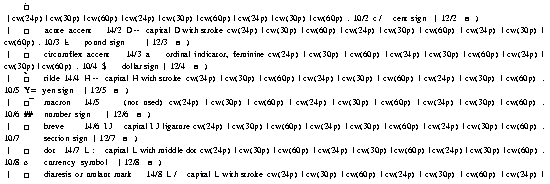
cw(30p) | cw(60p) . 10/9 (not used) 12/9 14/9 O / capital O with slash cw(24p) | cw(30p) | cw(60p) | cw(24p) | cw(30p) | cw(60p) | cw(24p) | cw(30p) | cw(60p) . 10/10 (not used) { 12/10a)

| cw(60p) | cw(24p) | cw(30p) | cw(60p) . 11/0 ° degree sign { 13/0 a)
|
} 11/1 ± } 11/2 2 |
(not used) 15/0 k small k, Greenlandic cw(24p) | cw(30p) | cw(60p) | cw(24p) | cw(30p) | cw(60p) | cw(24p) | cw(30p) | cw(60p) . plus/minus sign { 13/1 b) (not used) 15/1 a e small a e dipthong cw(24p) | cw(30p) | cw(60p) | cw(24p) | cw(30p) | cw(60p) | cw(24p) | cw(30p) | cw(60p) . superscript 2 { 13/2 a) |
|
|
} 11/3 3 |
(not used) 15/2 d small d with stroke cw(24p) | cw(30p) | cw(60p) | cw(24p) | cw(30p) | cw(60p) | cw(24p) | cw(30p) | cw(60p) . superscript 3 { 13/3 b) |
|
|
} 11/4 × } 11/5 m } 11/6 } 11/7 × } 11/8 ÷ } 11/9 } 11/10 } 11/11 } cw(60p) . } cw(60p) . } cw(60p) . |
(not used) 15/3 . small eth, Icelandic cw(24p) | cw(30p) | cw(60p) | cw(24p) | cw(30p) | cw(60p) | cw(24p) | cw(30p) | cw(60p) . multiply sign { 13/4 a) (not used) 15/4 h small h with stroke cw(24p) | cw(30p) | cw(60p) | cw(24p) | cw(30p) | cw(60p) | cw(24p) | cw(30p) | cw(60p) . micro sign { 13/5 b) (not used) 15/5 i small i without dot cw(24p) | cw(30p) | cw(60p) | cw(24p) | cw(30p) | cw(60p) | cw(24p) | cw(30p) | cw(60p) . paragraph sign, pilcrow { 13/6 a) (not used) 15/6 ij small ij ligature cw(24p) | cw(30p) | cw(60p) | cw(24p) | cw(30p) | cw(60p) | cw(24p) | cw(30p) | cw(60p) . middle dot { 13/7 b) (not used) 15/7 l× small l with middle dot cw(24p) | cw(30p) | cw(60p) | cw(24p) | cw(30p) | cw(60p) | cw(24p) | cw(30p) | cw(60p) . divide sign { 13/8 a) (not used) 15/8 l / small l with stroke cw(24p) | cw(30p) | cw(60p) | cw(24p) | cw(30p) | cw(60p) | cw(24p) | cw(30p) | cw(60p) . (not used) { 13/9 b) (not used) 15/9 o / small o with slash cw(24p) | cw(30p) | cw(60p) | cw(24p) | cw(30p) | cw(60p) | cw(24p) | cw(30p) | cw(60p) . (not used) { 13/10a) (not used) 15/10 oe small oe ligature cw(24p) | cw(30p) | cw(60p) | cw(24p) | cw(30p) | cw(60p) | cw(24p) | cw(30p) | cw(60p) . >> angle quotation mark right { 13/11b) (not used) 15/11 B small sharp s, German cw(24p) | cw(30p) | cw(60p) | cw(24p) | cw(30p) | cw(60p) | cw(24p) | cw(30p) | 11/12 ¼ fraction one quarter { 13/12a) (not used) 15/12 | fR o small thorn. Icelandic cw(24p) | cw(30p) | cw(60p) | cw(24p) | cw(30p) | cw(60p) | cw(24p) | cw(30p) | 11/13 ½ fraction one half { 13/13b) (not used) 15/13 - t small t with stroke cw(24p) | cw(30p) | cw(60p) | cw(24p) | cw(30p) | cw(60p) | cw(24p) | cw(30p) | 11/14 ¾ fraction three quarters { 13/14a) |
64 Fascicle VII.3 -- Rec. T.61
} (not used) 15/14 h small eng, Lapp cw(24p) | cw(30p) | cw(60p) | cw(24p) | cw(30p) | cw(60p) | cw(24p) | cw(30p) | cw(60p) . 11/15 ? inverted question { 13/15b)
} (not used) cw(24p) | cw(30p) | cw(60p) | cw(24p) | cw(30p) | cw(60p) | cw(24p) | cw(30p) | cw(60p) . mark left
a) Diacritical marks are illustrated together with a rectangle representing the relative position of the graphic character with which they are normally associated.
b) In the 1980 version of this Recommendation, code 12/9 was allocated to represent the umlaut mark. The use of this facility is discouraged. Its removal is foreseen in the future.
Tableau 2/T.61 [T3.61] A L'ITALIENNE, p.22
Fascicle VII.3 -- Rec. T.61 65
Figure 3/T.61, p.23 66 Fascicle VII.3 -- Rec. T.61
Fascicle VII.3 -- Rec. T.61 67